
I skipped posting at the beginning of August because I was consumed with logistical work for a new semester. But I’m catching up – because it’s important to move forward in whatever way you can, despite the imperfections (which references one of my favorite time management books, but that’s another post for another month).
With that, we’ll get into the recommendations.
I celebrate traditional New Years Eve on January 1, like most people. But in terms of my professional work, my real “new year” begins in August. I spend the summer taking a break from classes, of course, but it’s also my time to reflect on curriculum, and how I can be more present for myself as well as my students. Rather than highlight books about education in an academic sense, I chose selections that discuss focus, or lack thereof, and the forces that work to commoditize our attention and create barriers to learning.
As I’ve mentioned in the “about” section of this blog, I decided to ditch my social media accounts. Facebook, Instagram, Twitter – gone. Technically, I still have Bluesky. But it’s not anything I spend too much time on. When you’re on an app that doesn’t get as much traffic or as much drama, it’s clear why you were drawn to the more popular platforms. And it’s also painfully obvious how much time you spend endlessly scrolling when you can no longer access the content everyone else is talking about. I’m not saying social media is all bad. But these books illuminate in stark fashion the damage they inflict on the fabric of our society. No matter your political leanings, the algorithms are programmed to predict your interests to a frightening degree of accuracy, and it’s proven – much of the evidence in these books – that it does everything possible to keep you logged in, liking, commenting, buying, and watching.
Research validates the negative connotations associated with spending a lot of time on social media platforms. The algorithms feed off turmoil and rage. The more incendiary the post, the more people interact. It was around the height of Covid that I read “10 Arguments for Deleting Your Social Media Accounts Right Now,” by Jaron Lanier that I realized how much I was contributing to this dynamic by engaging in heated debates on my page. While I had amassed a decent sized following of supporters who liked and loved just about everything I typed, the arguments in this book made me wonder if: 1. If my behavior was performative, and 2. If there were more effective ways to use my voice to make connections and bring about actual change.
While some of these books are more practical and some are more philosophical, the authors share some powerful insights into why this technology is so addictive and how it siphons off the finite amount of time we get on this earth. The authors in this month’s collection of recommendations explore the mechanics of these apps, our smartphones, the prevalence of black and white thinking, and why this is a detriment to brain development and civil discourse. For me, the moral dilemmas presented in these books made most participation untenable. But everyone must find their balance. If you’re looking to reimagine your relationship with social media or your phone, if you’re a parent, a teacher, or someone generally concerned about the time you spend online, these books are fascinating reads.
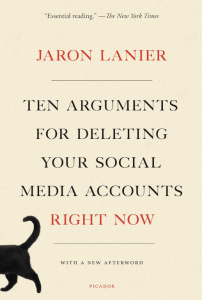
“10 Arguments for Deleting Your Social Media Accounts Right Now,” by Jaron Lanier
This was a very consequential read for me. During the pandemic, I became increasingly disillusioned with people and how we treat each other. Social media sites in particular were platforms for some of the most callous, incendiary, and factually inaccurate interactions, it made me question why I devoted any precious time or mental energy engaging in interactions that often left me angry and sad. In the subsequent weeks, I began to experiment with taking breaks from the online spaces – where I actually had a pretty devoted following of people who “liked” my posts and would continually encourage me to run for political office. I appreciated the validation, but in the context of covid, became more uncomfortable with that level of attention on these platforms. It was around this time I heard of Lanier’s book. He is a tech pioneer and considered to be the father of virtual reality. The book is broken into numbered chapters that explore specific issues related to the mechanics of these platforms, the ways in which they’re designed to hold your attention, and the insidious nature of the algorithms – which actually feed off of negative interactions. So much of what he said aligned with everything I was experiencing at that time and highlighted the toll participation was taking on my mental and to a certain extent, physical health. Jaron does not maintain any presence on social media and advocates for different approaches to “build a presence.” I took this to heart as I believe my prior posts definitely raised awareness but likely did not affect actionable change. Whether you’re looking to take the plunge and remove all your accounts, or dramatically change your relationship with social media, this is a great read.
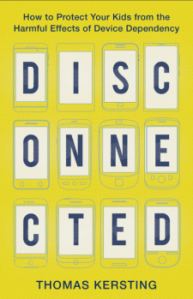
“Disconnected: How to Protect Your Kids from the Harmful Effects of Device Dependency,” by Thomas Kersting
This book is written by a former principal and contains lots of great information if you are struggling with helping kids to manage their relationship with their smart phone. While it is very direct in this manner, the information is l, regardless of whether you have children of your own. More importantly, the author provides powerful insights into the forces that influence younger generations, which is helpful for the adults scrambling to stay ahead of the curve. While some of the advice given smacks of ageism and comes off as a bit antiquated, there were many instances where the reading made me examine my own habits with my phone and the kind of example I wanted to set for young people. This is very straightforward and full of practical advice. I also included this book for any of my fellow educators, especially those who teach K12.
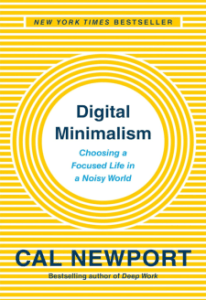
“Digital Minimalism: Choosing a Focused Life in a Noisy World,” by Cal Newport
I am a Cal Newport fangirl of the highest order. I’ve read several books about focus, time management, and how to prioritize what is important in knowledge-driven, autonomous work environments (ACADEMIA!) So, while the previous book may be more beneficial to teachers and parents, this book is for my fellow professors navigating an increasingly burdensome workload in higher education. And guess what – it also involves spending less time on your phone. I’ve employed many of these practices on the heels of deleting my social media accounts, because something you may not expect is how much time you spend searching, reading, playing games, etc. I believe it is this book that contains anecdotes about refocusing your attention after receiving a notification from your phone. It can take as much as 25 minutes (!!!) to jump back into a task that was previously interrupted by a ding or a chime. I’m definitely still learning, still working to be present in the ways in which I engage with the world around me. But the advice and strategies in the book for building focus are things I aspire towards. While he writes mostly for academics in particular, there are a host of other professions and practices where the advice is applicable. I highly recommend it for those who are concerned about their ability to think deeply and improve the ability to concentrate.
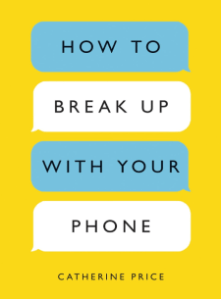
“How to Break Up with Your Phone: The 30-Day Plan to Take Back Your Life,” by Catherine Price
This book is also full of practical advice to re-think your relationship with your phone and how it affects your daily routine. I always think back to this when people arbitrarily turn their screens to grayscale in an attempt to lose interest and ultimately, spend less time engaged with apps. But as Catherine says, that doesn’t do much to really examine WHY your phone has become an extension of your arm. Her plan is quite regimented but is designed to build discipline as well as a tolerance for not having it by your side 24/7. She addresses arbitrary “life hacks,” and instead looks at the psychology behind our attachment. This is a very practical guide to curbing phone use if you’re looking to recalibrate how you interact with your phone.
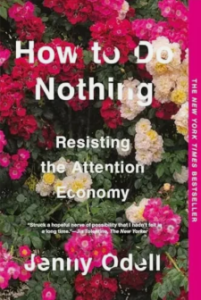
“How To Do Nothing: Resisting the Attention Economy,” by Jenny Odell
“How To Do Nothing,” is less a manifesto with step-by-step instructions for checking out of the social media sphere than it is a collection of essays that contemplate what we pay attention to and how we consume time. Although I enjoyed the meandering pace of the book, and profound observations from her lived experiences, many people panned her writing as incoherent and rambling. While I agree, her sophomore writing effort is much more cohesive, and maybe gets to some of what she was trying to communicate here across in a more cogent manner, I believe there are some valuable takeaways from this book. One of my favorite stories is about her love of bird watching and how she befriended a crow who took up residence on her apartment balcony. Again, this might not be for everyone. But it does tie into the theme of focus and awareness in ways that could be helpful for people who are contemplating their place in all of this (gestures broadly around).






Leave a Reply